
Health
Emerado Volunteer Fire Department extinguishes 2-acre fire
By Amina El-Amin
Advertisement · Why this ad?
Henry has a Bachelor’s degree in Communication from North Dakota State University and has spent three years focusing on educational policy and community engagement in schools for the Grafton News. He aims to connect educational initiatives with community needs.
More from Henry →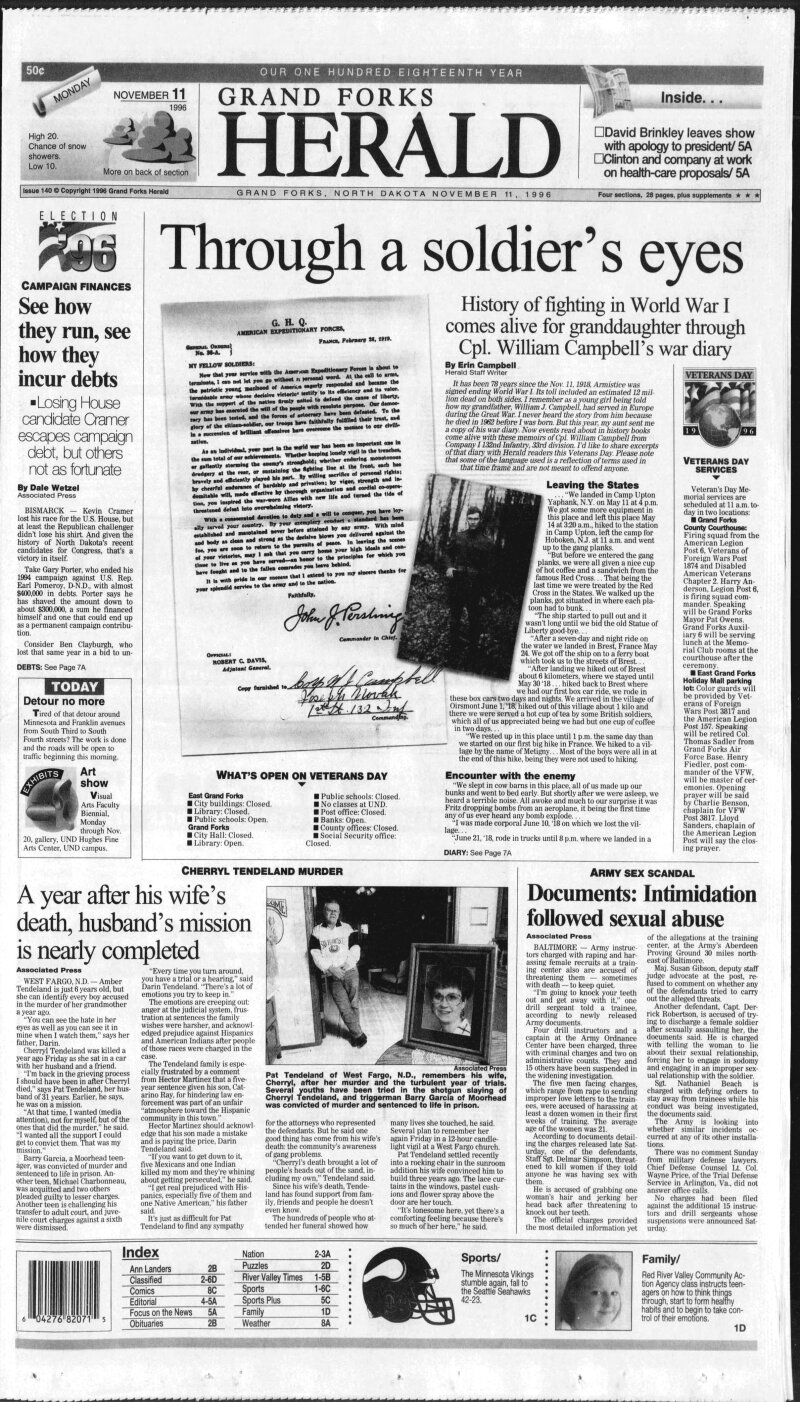
The crisp autumn air carries the scent of woodsmoke and the promise of a quiet evening, a stark contrast to the horrors etched in ink on fragile pages. This week, as we pause to remember those who served, the Grand Forks Herald brings us a poignant glimpse into the past – a window into the soul of a soldier through the handwritten diary of Cpl. William J. Campbell, a Grafton native who braved the trenches of World War I. It’s a story unearthed by his granddaughter, Erin Campbell, who now shares his words with us, allowing us to connect with a generation tested by unimaginable adversity. The year was 1996, 78 years after the Armistice of Nov. 11, 1918, brought an end to the Great War – a conflict that claimed an estimated 12 million lives. World War I left an indelible mark on the world, and now, through Cpl. Campbell’s diary, we can understand the personal toll it took on a young man from our own community.
Cpl. Campbell's diary entries, penned with a simple honesty and humility, offer a raw and intimate portrayal of life on the front lines. The young soldier, then just a boy, meticulously documented his journey from Camp Upton in New York to the battlefields of France, capturing the mundane moments of preparation and the sheer terror of combat. The first entries detail the anticipation and apprehension felt by American troops as they embarked on a perilous voyage across the Atlantic, leaving behind the familiar comforts of home. “But before we entered the gang planks, we were all given a nice cup of hot coffee and a sandwich from the famous Red Cross…That being the last time we were treated by the Red Cross in the States,” he wrote, a small kindness that underscored the vastness of the journey ahead. His words paint a vivid picture of the cramped conditions aboard ship and the initial excitement of arriving in France, quickly tempered by the harsh realities of war. The American Red Cross, a beacon of hope for soldiers, provided those early comforts.
As Cpl. Campbell’s journey progressed, the diary entries became increasingly harrowing, detailing encounters with enemy fire, relentless shelling, and the constant threat of death. He describes his promotion to corporal on June 10, 1918, a bittersweet moment amidst the chaos of battle. “I was made corporal June 10, '18 on which we lost the village…” The entries reveal a young man grappling with fear and duty, striving to maintain his composure while witnessing unimaginable suffering. The descriptions of the gas attacks are particularly chilling, a stark reminder of the brutal and indiscriminate nature of warfare. “On the morning of Sept. 20 we had a gas attack by the Boche. They shot over 268 shells in 48 minutes, most of them were high explosive shells with gas.” The diary serves as a powerful testament to the courage and resilience of those who fought in World War I, and a solemn reminder of the sacrifices made to secure the freedoms we enjoy today.
The diary's impact extends beyond its historical significance; it’s a deeply personal story that resonates with families and communities. Erin Campbell’s decision to share her grandfather’s words is a testament to the enduring power of family history and the importance of preserving the memories of those who served. “I remember as a young girl being told how my grandfather, William J. Campbell, had served in Europe during the Great War,” she wrote in her 1996 Herald article. “I never heard the story from him because he died in 1962 before I was born.” Her sharing of this family treasure connects generations, allowing us to understand the experiences of those who came before us and to appreciate the sacrifices they made.
Cpl. Campbell’s diary provides a remarkable chronicle of his deployment, beginning with the departure from Camp Upton, New York. He meticulously details the journey across the Atlantic, noting the small comforts like a cup of coffee and a sandwich from the Red Cross before boarding the ship. “We landed in Camp Upton Yaphank, N.Y. on May 11 at 4 p.m. We got some more equipment in this place and left this place May 14 at 3:20 a.m., hiked to the station in Camp Upton, left the camp for Hoboken, N.J. at 11 a.m.” His descriptions of the voyage and subsequent arrival in Brest, France, paint a vivid picture of the challenges faced by American soldiers entering the war effort. The grueling hikes and rudimentary living conditions, such as sleeping in cow barns, underscore the hardships endured by those serving on the front lines.
As Cpl. Campbell’s time in France progressed, his diary entries reflect the escalating intensity of the war. He recounts his first experience with enemy fire – a bombing attack while sleeping in a barn – and details the constant threat of artillery strikes. “We slept in cow barns in this place, all of us made up our bunks and went to bed early. But shortly after we were asleep, we heard a terrible noise. All awoke and much to our surprise it was Fritz dropping bombs from an aeroplane, it being the first time any of us ever heard any bomb explode…” He also describes the capture of prisoners, the loss of villages, and the constant movement between sectors. One particularly harrowing entry recounts a daylight patrol where a German sniper shattered a fellow soldier’s rifle. “On Aug. 3, '18 three men from our scouts section went out on a daylight patrol … One of the men had his rifle busted all to pieces when a German sniper opened fire on them, making a direct hit on his rifle.”
Cpl. Campbell’s diary frequently mentions the Somme front, a region notorious for its intense fighting and heavy casualties. He describes the relentless shelling and the constant threat of attack, highlighting the psychological toll on the soldiers. The diary entries reveal the camaraderie among the men, as well as the deep sense of loss felt when comrades fell in battle. His observations of encounters with Australian soldiers underscore the multinational nature of the Allied effort and the shared experiences of soldiers from different nations facing a common enemy.
Cpl. Campbell’s diary reveals not only the horrors of war but also moments of unexpected connection and cooperation with Allied forces. He recounts an encounter with British soldiers who offered them a welcome cup of tea after a long hike, and describes the relief felt by Australian soldiers when American troops arrived to provide support. “Mid-August: The Australians had driven the Boche back and many German bodies were still lying on the field… After a long tiresome hike, we hit the front line and the Australian soldiers were very glad to see us come to give them aid as they sure were in a bad position.” These interactions highlight the importance of international cooperation in overcoming adversity and achieving common goals.
One particularly compelling entry details Cpl. Campbell’s reconnaissance mission to Le-Mort Homme, or Dead Man’s Hill. The perilous climb and the subsequent sniper fire underscore the constant danger faced by soldiers even during seemingly routine tasks. “On Sept. 18 another corporal and myself went out to see if we could find another observation post… We started out. We hiked to a large hill, the French name of it is Le-Mort Homme, better known as Dead Mans Hill…” The observation post provided a strategic vantage point, allowing the soldiers to gather valuable intelligence about enemy positions. This episode highlights the importance of reconnaissance in military operations and the bravery of those who risked their lives to gather crucial information.
The publication of Cpl. Campbell’s diary in 1996 sparked a renewed interest in local military history. The Grafton Historical Society has taken on the responsibility of safeguarding local military records and artifacts, ensuring that the stories of our veterans are not lost to time. Efforts are underway to digitize these materials, making them accessible to a wider audience through online archives and exhibits. The community has also embraced the importance of oral history projects, encouraging veterans and their families to share their experiences firsthand. By preserving these stories, future generations can gain a deeper understanding of the sacrifices made by those who served and the importance of honoring their legacy. Grafton, North Dakota is committed to ensuring that the memory of Cpl. Campbell and all veterans is kept alive.
Resources for those interested in learning more about World War I and supporting veterans can be found at the Department of Veterans Affairs website and the Military.com website. Let us all take a moment this Veterans Day to reflect on the sacrifices made by those who have served, and to express our gratitude for their unwavering commitment to our nation.
By Amina El-Amin

By Clara Jensen

By Lydia Smallwood
By Lydia Smallwood